OUR NEWS

Recent blogs

BLOG

3 kW vs 5 kW Rooftop Solar System: Which Sizing Fits Your Home in Tamil Nadu?
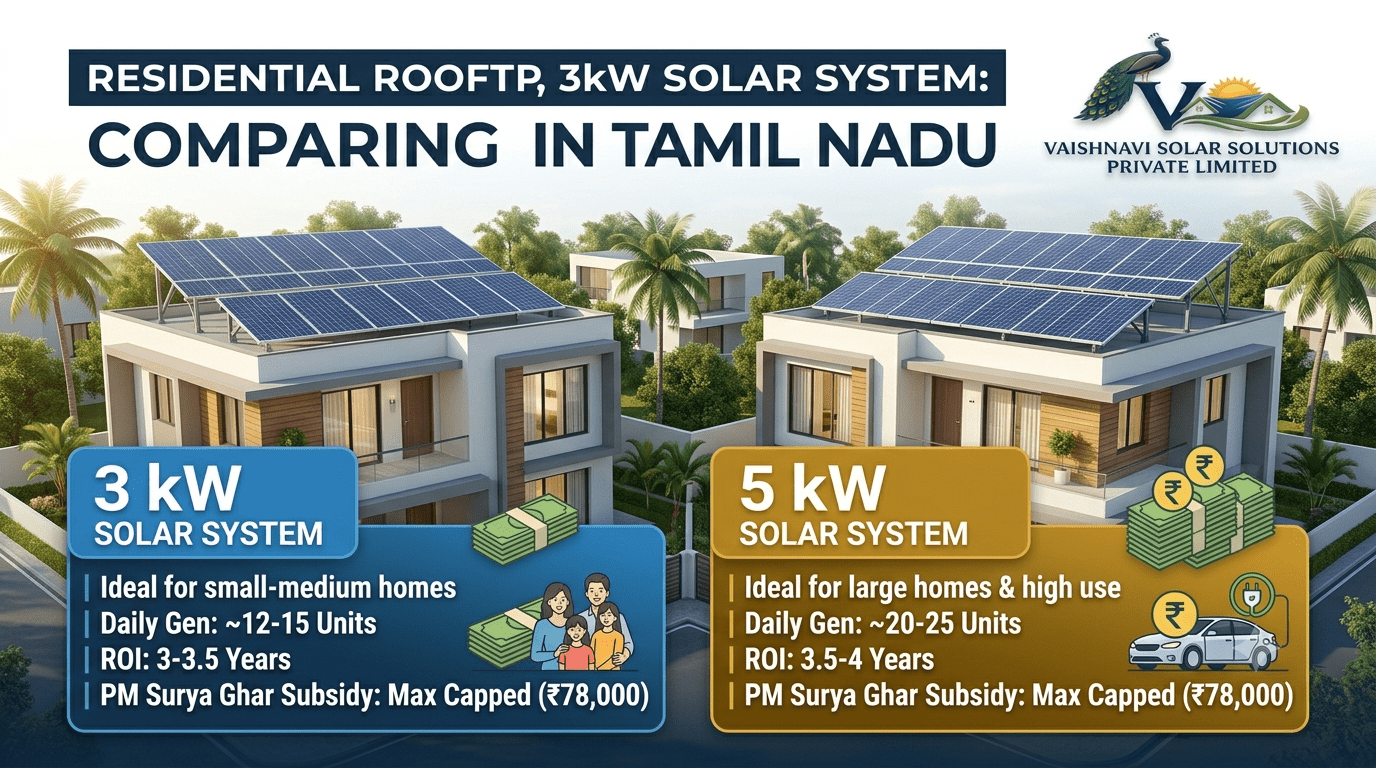
3 kW versus 5 kW rooftop solar panel comparison banner showing daily power generation and system costs.
Complete comparison guide between 3 kW and 5 kW rooftop solar systems for Tamil Nadu homeowners.

Switching your home to rooftop solar energy is one of the most effective ways to permanently lower high bi-monthly TANGEDCO electricity bills. However, when evaluating solar options in Tamil Nadu, most homeowners face a common dilemma right at the beginning: Should I install a 3 kW solar system or upgrade to a 5 kW solar system?

Choosing the right capacity isn’t just about picking a random number. Installing a system that is too small leaves you paying out-of-pocket for extra grid units during peak summer months. On the flip side, installing a system that is oversized for your actual needs increases your initial setup investment without delivering extra financial returns.

Whether you live in Sivakasi, Virudhunagar, Madurai, or anywhere across Tamil Nadu, this detailed comparison guide breaks down daily power generation, roof space demands, net investment costs, and PM Surya Ghar subsidy calculations to help you choose the right capacity for your household.

Understanding Your Daily Power Consumption & TANGEDCO Bill Slabs

Before picking a system size, you need to analyze your home’s bi-monthly electricity bill and appliance usage pattern.

In Tamil Nadu, TANGEDCO uses progressive tariff slabs—meaning the more electricity you consume above 500 units bi-monthly, the higher the rate per unit becomes. Eliminating those high-tier consumption units gives you the fastest financial payback on your solar investment.

When a 3 kW System is Sufficient

A 3 kW system fits standard 2 to 3-bedroom independent homes where the bi-monthly TANGEDCO bill ranges between ₹2,500 and ₹4,500 (consuming around 300 to 450 units per month). It easily powers daily lighting, ceiling fans, home entertainment, kitchen appliances, and one 1.5-ton inverter air conditioner running during afternoon hours.

When You Should Upgrade to a 5 kW System

A 5 kW system is built for larger 3 to 4-bedroom homes or multi-family properties with bi-monthly bills exceeding ₹6,000 to ₹10,000 (consuming 600+ units per month). If your household runs 2 or 3 air conditioners simultaneously, uses a heavy domestic water pump, or charges an electric vehicle (EV) overnight, 5 kW provides the daily power buffer required to keep grid imports near zero.

To evaluate your roof space and calculate custom unit savings based on your latest bill, explore our Main Homepage for custom system sizing.

3 kW vs 5 kW Solar System: Direct Feature Comparison

The table below outlines the core technical and financial specifications for residential rooftop solar setups in Tamil Nadu:

Comparison Parameter3 kW Rooftop Solar System5 kW Rooftop Solar System
Average Daily Unit Generation12 – 15 Units / Day20 – 25 Units / Day
Average Monthly Generation360 – 450 Units / Month600 – 750 Units / Month
Shadow-Free Roof Space Required250 – 300 Sq. Ft.450 – 500 Sq. Ft.
Typical Turnkey System Cost₹1,80,000 – ₹2,10,000₹2,80,000 – ₹3,30,000
PM Surya Ghar Government Subsidy₹78,000 (Maximum Cap)₹78,000 (Capped at 3 kW rate)
Net Out-of-Pocket Cost₹1,02,000 – ₹1,32,000₹2,02,000 – ₹2,52,000
Average Payback Period3.0 to 3.5 Years3.5 to 4.2 Years

Note: Pricing reflects standard Mono-PERC / TOPCon solar modules with Tier-1 grid-tied string inverters under current market conditions.

Government Subsidy Impact: The PM Surya Ghar Sizing Cap

Infographic comparing 3 kW and 5 kW solar systems in terms of daily output, roof space, and appliance capacity.
Side-by-side comparison chart of 3 kW vs 5 kW rooftop solar specifications.

One crucial factor every homeowner in Tamil Nadu must know is how central government subsidies apply to different system sizes under the PM Surya Ghar: Muft Bijli Yojana.

  • For 1 kW: ₹30,000 direct central subsidy.

  • For 2 kW: ₹60,000 direct central subsidy.

  • For 3 kW: ₹78,000 direct central subsidy (Calculated as ₹30,000 + ₹30,000 + ₹18,000).

  • For 5 kW (or higher): ₹78,000 maximum capped subsidy.

Because the central subsidy reaches its absolute ceiling at 3 kW, installing a 5 kW system does not yield extra government cash support. You receive the same ₹78,000 grant for a 5 kW plant as you do for a 3 kW plant.

However, even with the subsidy capped at ₹78,000, a 5 kW system remains highly profitable for high-consumption households because the extra 10 to 12 daily units generated offset high-tier TANGEDCO commercial/domestic tariff rates, allowing you to recover the higher out-of-pocket setup cost in around 4 years.

Roof Space & Structural Requirements in Tamil Nadu

Before making a final choice, inspect your roof conditions to ensure your building can accommodate the physical panel layout.

Roof Space Requirements

  • A 3 kW setup using modern high-efficiency 540W+ panels requires approximately 5 to 6 physical modules, covering roughly 250 to 300 sq. ft. of unshaded space.

  • A 5 kW setup requires 9 to 10 physical modules, needing 450 to 500 sq. ft. of clear space.

Orientation and Shading

Panels in Tamil Nadu must be installed facing True South at a tilt angle of 10 to 15 degrees to maximize solar irradiance throughout the year. Make sure nearby water tanks, stairwell towers, parapet walls, or trees do not cast shadows across the roof between 9:00 AM and 4:00 PM.

To review hardware component details, certified mounting structures, and inverter specifications, visit our Rooftop Solar Services Page.

How to Decide: Which Size Should You Buy?

Pick a 3 kW System if:

  1. Your bi-monthly TANGEDCO bill stays consistently under ₹4,500.

  2. Your usable shadow-free rooftop space is around 300 sq. ft.

  3. You want the highest possible subsidy-to-cost ratio (where government subsidy covers over 35–40% of the gross installation price).

Pick a 5 kW System if:

  1. Your bi-monthly TANGEDCO bill regularly crosses ₹6,000 to ₹10,000.

  2. You run 2 or more air conditioners during peak summer days.

  3. You plan to buy an electric vehicle or install additional heavy home appliances in the next 1 to 2 years.

  4. You have 500+ sq. ft. of clear south-facing roof space.

Get an Authoritative Site Assessment Today

Still unsure which system size matches your home’s Sanctioned Service Connection load and daily usage? Our engineering team provides physical site surveys, shadow-path analyses, and return-on-investment payback reports across South Tamil Nadu.

At Vaishnavi Solar Solutions Private Limited, we coordinate the complete process—from TANGEDCO load enhancement filings to physical mounting and portal subsidy registration.

Ready to eliminate your electricity bills? Visit our Contact Us Page or call our technical team directly at +91 9080936356 for a free site consultation today!

OUR NEWS

Recent blogs

BLOG

TANGEDCO Net Metering Guide: How Solar Export Reduces Your Electricity Bill in Tamil Nadu

Bi-directional solar net meter installed on a residential home in Tamil Nadu connected to TANGEDCO power grid.
Complete guide to TANGEDCO net metering, bi-directional meters, and solar bill reductions in Tamil Nadu.

When homeowners and business owners across Tamil Nadu consider switching to rooftop solar, one question always comes up: What happens to the excess power my solar panels produce during sunny days when my house isn’t using it?

The answer lies in TANGEDCO Net Metering. Net metering is a special utility billing arrangement regulated by the Tamil Nadu Electricity Regulatory Commission (TNERC). It allows you to feed your surplus solar electricity directly into the public power grid. In return, TANGEDCO credits those units against the energy you consume at night or on rainy days.

Whether you live in Sivakasi, Virudhunagar, Madurai, or anywhere in Tamil Nadu, understanding how bi-directional net meters work helps you calculate your true monthly energy savings.

This guide breaks down the technical details, billing math, TANGEDCO approval steps, and rules for grid-connected solar systems.

What is TANGEDCO Net Metering and How Does It Work?

Traditional single-way electric meters only measure power coming into your home from the TANGEDCO grid. A bi-directional net meter, on the other hand, measures energy flow in two directions:

  1. Import Units (R1): Electricity drawn from the grid during nighttime or heavy appliance usage when solar power is insufficient.

  2. Export Units (R2): Surplus solar electricity pushed back into the TANGEDCO grid during sunny peak daylight hours.

At the end of your bi-monthly billing cycle, TANGEDCO subtracts your total exported units (R2) from your total imported units (R1). You only pay the electricity tariff for the net difference.

If your solar system produces more energy than your house consumes over the two months, your net imported units drop to zero, eliminating your energy unit charges.

Net Metering vs. Net Feed-in vs. Gross Metering in Tamil Nadu

Tamil Nadu’s current electricity framework offers three different metering models based on consumer category:

FeatureNet Metering (Domestic / Residential)Net Feed-in / Net Billing (Commercial & Industrial)Gross Metering (Large Generators)
Eligible CategoriesLT Domestic (Tariff 1A & 1D)Commercial, Industrial, Institutions (LT & HT)Commercial/Industrial >151 kW up to 999 kW
How Savings Work1:1 unit offset against consumptionMonetary credit calculated at fixed feed-in ratesEntire generation sold directly to utility
Surplus Unit CreditCarried forward to next billing cycleFinancial credit rolled overMonthly monetary payout
PM Surya Ghar Eligible?Yes (Up to ₹78,000 direct subsidy)NoNo

For residential homeowners, 1:1 Net Metering gives you the highest financial return because each solar unit generated directly offsets high-tier domestic consumption tariffs.

To see how net-metered solar setups fit your current roof, explore our Main Homepage for custom system sizing.

Step-by-Step TANGEDCO Net Metering Approval Process

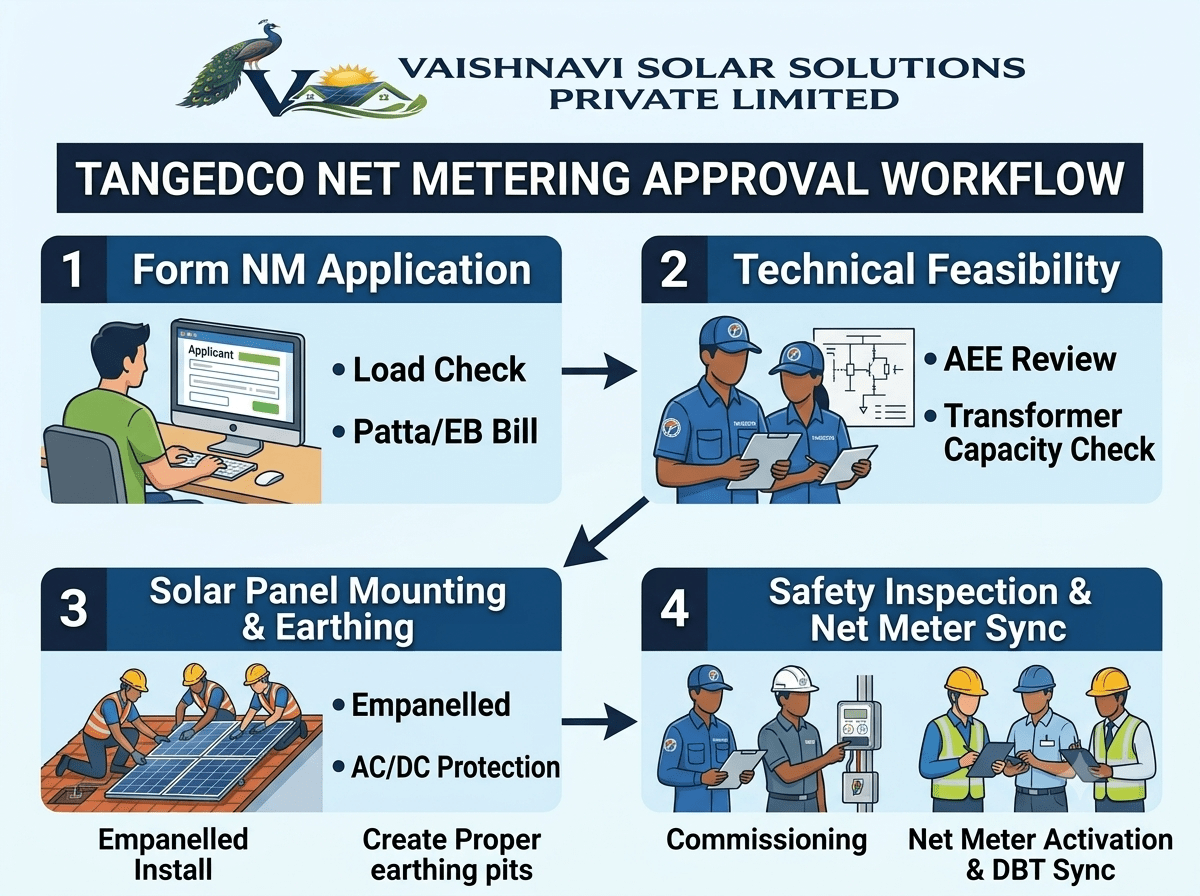
Connecting your rooftop solar plant to the power grid requires formal approvals from your local TANGEDCO section office. Here is how the end-to-end process works:

Bi-directional solar net meter installed on a residential home in Tamil Nadu connected to TANGEDCO power grid.
Complete guide to TANGEDCO net metering, bi-directional meters, and solar bill reductions in Tamil Nadu.

Step 1: Submitting Form NM and Sanction Load Verification

Before purchasing hardware, your installer submits Form NM (Net Metering Application) to TANGEDCO along with a nominal application fee.

Your proposed solar plant capacity (in kW) cannot exceed your sanctioned service connection load. For example, if your home has a 3 kW sanctioned load, your solar plant cannot exceed 3 kW unless you submit a load enhancement request first.

Step 2: Technical Feasibility Clearance

The local Assistant Executive Engineer (AEE) reviews your local distribution transformer capacity. Under TANGEDCO rules, grid-connected solar capacity on a local transformer is capped at 30% of the transformer’s total rated capacity. Approval is granted on a first-come, first-served basis.

Step 3: Physical Installation and Safety Inspection

Once feasibility is approved, physical mounting begins. Your vendor installs:

  • MNRE-approved Tier-1 solar modules.

  • A grid-tied inverter with certified anti-islanding protection (which automatically shuts down solar feed during local grid blackouts to protect line workers).

  • Dedicated AC/DC surge protection devices and proper earthing pits.

For system capacities below 10 kW, the TANGEDCO Assistant Executive Engineer (AEE) conducts the site inspection. For systems 10 kW and above, inspection clearance from the Tamil Nadu Electrical Inspectorate (TNEI) is required.

Step 4: Signing the Net Metering Agreement & Meter Replacement

After safety verification, you sign the formal Net Metering Agreement with TANGEDCO. The section office schedules an engineer to replace your old meter with an approved bi-directional net meter. Your solar plant is then officially energized and synced to the grid!

To review component specifications or request turnkey installation, visit our Rooftop Solar Services Page.

Understanding Solar Network Charges and Billing Adjustments

When reading your TANGEDCO bi-monthly bill after installing net metering, you will notice a small line item called Network Charges (or wheeling charges).

  • Under TNERC regulations, residential solar installations up to 10 kW pay only 20% of the standard network charge rate per unit of solar energy generated.

  • This nominal fee covers grid stabilization and maintenance, usually amounting to just a few hundred rupees per billing cycle.

  • It is automatically offset by the thousands of rupees you save on overall energy consumption charges.

What Happens to Unused Export Credits at the End of the Year?

If your solar plant consistently produces more units than you consume throughout the year, excess credits roll forward every two months. At the end of the annual settlement cycle (March 31st), TANGEDCO settles remaining unused export credits at the state regulatory commission’s benchmark tariff rate.

Eliminate Net Metering Delays with Expert Support

Filing net metering paperwork, calculating sanctioned load limits, and managing section office inspections on your own can take weeks of continuous follow-ups.

At Vaishnavi Solar Solutions Private Limited, our team handles the full net metering workflow—from initial feasibility applications and single-line diagram (SLD) drawings to inspection coordination and net meter installation.

Want to convert your home or business to solar without paperwork headaches? Visit our Contact Us Page or call our engineering team at +91 9080936356 for a free site feasibility survey today!

OUR NEWS

Recent blogs

BLOG

PM Surya Ghar Solar Subsidy in Tamil Nadu: How to Claim Up to ₹78,000 Step-by-Step

Modern residential home with solar panel installation in Tamil Nadu under the PM Surya Ghar Yojana subsidy program.
Learn how to claim up to ₹78,000 government subsidy for residential solar in Tamil Nadu (2026).

High bi-monthly electricity bills from TANGEDCO are a growing burden for homeowners across Tamil Nadu. With rising consumption tariff slabs, keeping your monthly home budget under control gets harder every year. Fortunately, the central government’s PM Surya Ghar: Muft Bijli Yojana offers direct financial support to help residential households switch to rooftop solar energy.

If you own a home in Sivakasi, Virudhunagar, Madurai, or anywhere in Tamil Nadu, you can receive up to ₹78,000 credited directly to your bank account when you install a grid-tied rooftop solar system.

This detailed guide breaks down the exact subsidy rates, eligibility criteria, required documents, and approval steps so you can cut your electricity bills down to near zero.

Understanding the PM Surya Ghar Rooftop Solar Subsidy Breakdown

The government subsidy is not a single flat payout. Instead, the Ministry of New and Renewable Energy (MNRE) calculates Central Financial Assistance (CFA) based on the exact generation capacity (in kilowatts) installed on your roof.

PM Surya Ghar Subsidy Rates in Tamil Nadu

Solar System SizeMonthly Electricity GenerationDirect Cash Subsidy (CFA)
1 kW System120 – 150 Units₹30,000
2 kW System240 – 300 Units₹60,000
3 kW System360 – 450 Units₹78,000 (Maximum Cap)
4 kW to 10 kW Systems480+ Units₹78,000 (Capped at 3 kW rate)

Data Source: MNRE Guidelines under PM Surya Ghar Yojana.

Why 3 kW is the Sweet Spot for Residential Solar in Tamil Nadu

For most 3 to 4-bedroom houses running ceiling fans, lights, a refrigerator, a washing machine, and 1 or 2 air conditioners, a 3 kW system hits the perfect balance.

A turnkey 3 kW installation costs approximately ₹1,90,000 to ₹2,20,000 depending on panel efficiency and mounting structure height. When you subtract the ₹78,000 PM Surya Ghar subsidy, your net personal investment drops to roughly ₹1,12,000 to ₹1,42,000. Because this setup generates about 12 units of electricity every day, most Tamil Nadu families recover their net setup cost within 3.5 to 4.5 years.

If you want to check what system capacity fits your current roof space and bill usage, visit our Main Homepage to explore system sizing details.

Step-by-Step Guide to Applying for PM Surya Ghar Subsidy at pmsuryaghar.gov.in

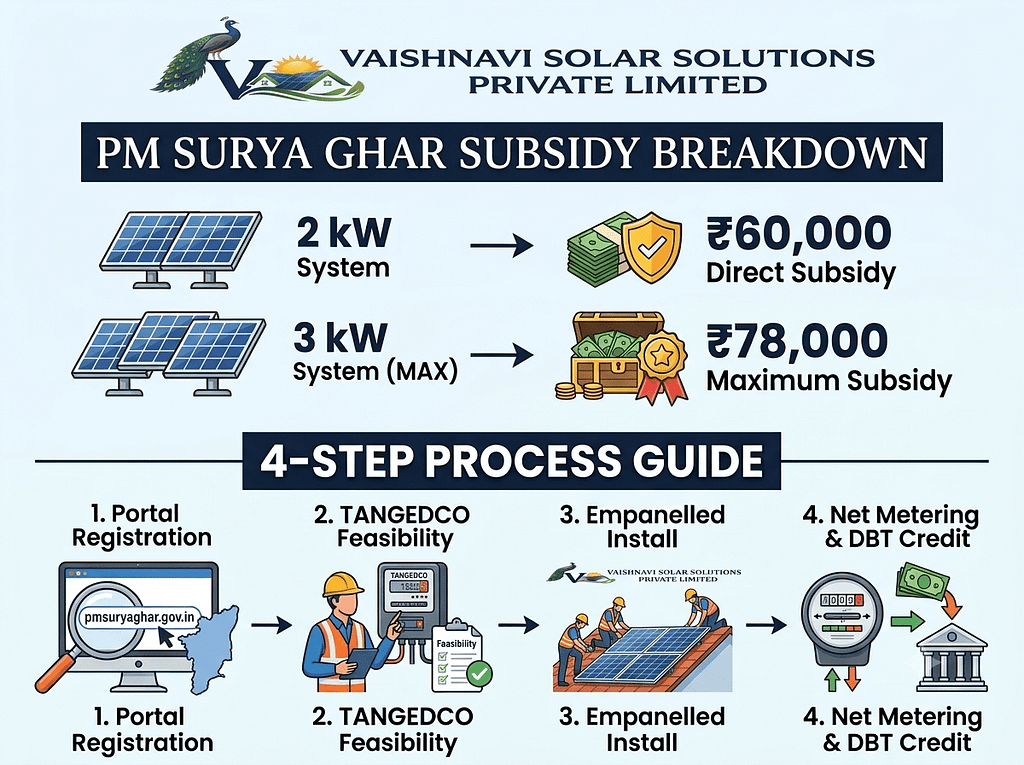
To ensure your subsidy is approved without portal rejections, follow these four chronological phases:

Infographic chart detailing the PM Surya Ghar solar subsidy rate slabs and the 4-step workflow (Registration, Feasibility, Install, Net Metering) for TANGEDCO consumers.
Visual guide explaining the PM Surya Ghar subsidy rates based on system size and the four key approval steps.

Step 1: Initial Registration on the National Portal

  1. Visit the official portal at https://pmsuryaghar.gov.in/

  2. Select Tamil Nadu as your state and pick TANGEDCO as your electricity distribution company (DISCOM).

  3. Enter your 9-digit TANGEDCO Consumer Number exactly as it appears on your current paper or digital electricity bill.

  4. Provide your mobile number linked to Aadhaar to generate an OTP and complete account creation.

Step 2: Feasibility Approval from TANGEDCO

  • Once registered, log in to submit your formal application for rooftop solar installation. TANGEDCO local engineers review your local transformer capacity to verify that your grid connection can accept solar feed-in. Feasibility approval usually takes 3 to 7 working days.

Step 3: Installation via an Empanelled Solar EPC Vendor

After feasibility clearance, you must choose an approved solar installer registered on the central portal.

  • Work with our experienced engineering team through our dedicated Rooftop Solar Services Page to choose high-efficiency mono-PERC solar panels and grid-tied inverters built to withstand coastal heat and monsoon weather in Tamil Nadu.

Step 4: Net Meter Installation, Inspection, and Direct Subsidy Transfer

  1. After physical mounting and electrical wiring are complete, your vendor submits the work completion report and system photo proofs on the portal.

  2. TANGEDCO technicians inspect the setup and replace your old single-way energy meter with a bi-directional net meter.

  3. The inspector issues a Commissioning Certificate on the portal.

  4. Enter your bank details (cancelled cheque / passbook copy) on the portal. The ₹78,000 cash subsidy is deposited straight into your bank account via Direct Benefit Transfer (DBT) within 30 to 45 days.

Required Documents for Solar Subsidy in Tamil Nadu

Keep scanned copies of the following documents ready before starting your portal application to avoid verification delays:

  • TANGEDCO Electricity Bill: Must show active LT domestic status and match the property address.

  • Aadhaar Card: Must be linked with your active mobile number for OTP sign-offs.

  • Property Proof: Patta, Sale Deed, or recent Municipal Property Tax receipt verifying roof ownership.

  • Bank Passbook or Cancelled Cheque: Must clearly display the account holder’s name, account number, and IFSC code for DBT credit.

  • Applicant Passport Photo: Standard digital photo upload.

Common Mistakes That Delay PM Surya Ghar Subsidy Payouts

Many homeowners face delayed payouts due to minor administrative oversights during registration. Avoid these three common pitfalls:

1. Name Mismatch Between TANGEDCO Bill and Bank Account

  • The name on your electricity bill, Aadhaar card, and bank account must match. If the EB connection is still registered under a parent’s or previous owner’s name, complete a quick name transfer at your local TANGEDCO section office before applying.

2. Hiring Non-Empanelled Local Contractors

  • Subsidies are strictly tied to installations carried out by MNRE and TEDA empanelled vendors. Hiring unapproved local electricians means you will lose eligibility for the central ₹78,000 financial grant.

3. Insufficient Shadow-Free Roof Space

  • Installing solar panels near high parapet walls, water tanks, or coconut trees reduces daily energy production. Make sure your roof has 80 to 100 sq. ft. of unshaded, south-facing space per kilowatt.

Get Professional Help for Your Solar Installation in Tamil Nadu

  • Handling portal registrations, DISCOM paperwork, and net meter coordination on your own can feel overwhelming. At Vaishnavi Solar Solutions Private Limited, we manage the entire process for you—from initial site assessment and TANGEDCO approvals to physical mounting and portal subsidy filing.
  • Ready to cut your electricity bill and secure your government subsidy? Head over to our Contact Us Page or call our technical team directly at +91 9080936356 for a free site assessment today!