

TANGEDCO Net Metering Guide: How Solar Export Reduces Your Electricity Bill in Tamil Nadu

When homeowners and business owners across Tamil Nadu consider switching to rooftop solar, one question always comes up: What happens to the excess power my solar panels produce during sunny days when my house isn’t using it?
The answer lies in TANGEDCO Net Metering. Net metering is a special utility billing arrangement regulated by the Tamil Nadu Electricity Regulatory Commission (TNERC). It allows you to feed your surplus solar electricity directly into the public power grid. In return, TANGEDCO credits those units against the energy you consume at night or on rainy days.
Whether you live in Sivakasi, Virudhunagar, Madurai, or anywhere in Tamil Nadu, understanding how bi-directional net meters work helps you calculate your true monthly energy savings.
This guide breaks down the technical details, billing math, TANGEDCO approval steps, and rules for grid-connected solar systems.
What is TANGEDCO Net Metering and How Does It Work?
Traditional single-way electric meters only measure power coming into your home from the TANGEDCO grid. A bi-directional net meter, on the other hand, measures energy flow in two directions:
Import Units (R1): Electricity drawn from the grid during nighttime or heavy appliance usage when solar power is insufficient.
Export Units (R2): Surplus solar electricity pushed back into the TANGEDCO grid during sunny peak daylight hours.
At the end of your bi-monthly billing cycle, TANGEDCO subtracts your total exported units (R2) from your total imported units (R1). You only pay the electricity tariff for the net difference.
If your solar system produces more energy than your house consumes over the two months, your net imported units drop to zero, eliminating your energy unit charges.
Net Metering vs. Net Feed-in vs. Gross Metering in Tamil Nadu
Tamil Nadu’s current electricity framework offers three different metering models based on consumer category:
| Feature | Net Metering (Domestic / Residential) | Net Feed-in / Net Billing (Commercial & Industrial) | Gross Metering (Large Generators) |
| Eligible Categories | LT Domestic (Tariff 1A & 1D) | Commercial, Industrial, Institutions (LT & HT) | Commercial/Industrial >151 kW up to 999 kW |
| How Savings Work | 1:1 unit offset against consumption | Monetary credit calculated at fixed feed-in rates | Entire generation sold directly to utility |
| Surplus Unit Credit | Carried forward to next billing cycle | Financial credit rolled over | Monthly monetary payout |
| PM Surya Ghar Eligible? | Yes (Up to ₹78,000 direct subsidy) | No | No |
For residential homeowners, 1:1 Net Metering gives you the highest financial return because each solar unit generated directly offsets high-tier domestic consumption tariffs.
To see how net-metered solar setups fit your current roof, explore our Main Homepage for custom system sizing.
Step-by-Step TANGEDCO Net Metering Approval Process
Connecting your rooftop solar plant to the power grid requires formal approvals from your local TANGEDCO section office. Here is how the end-to-end process works:
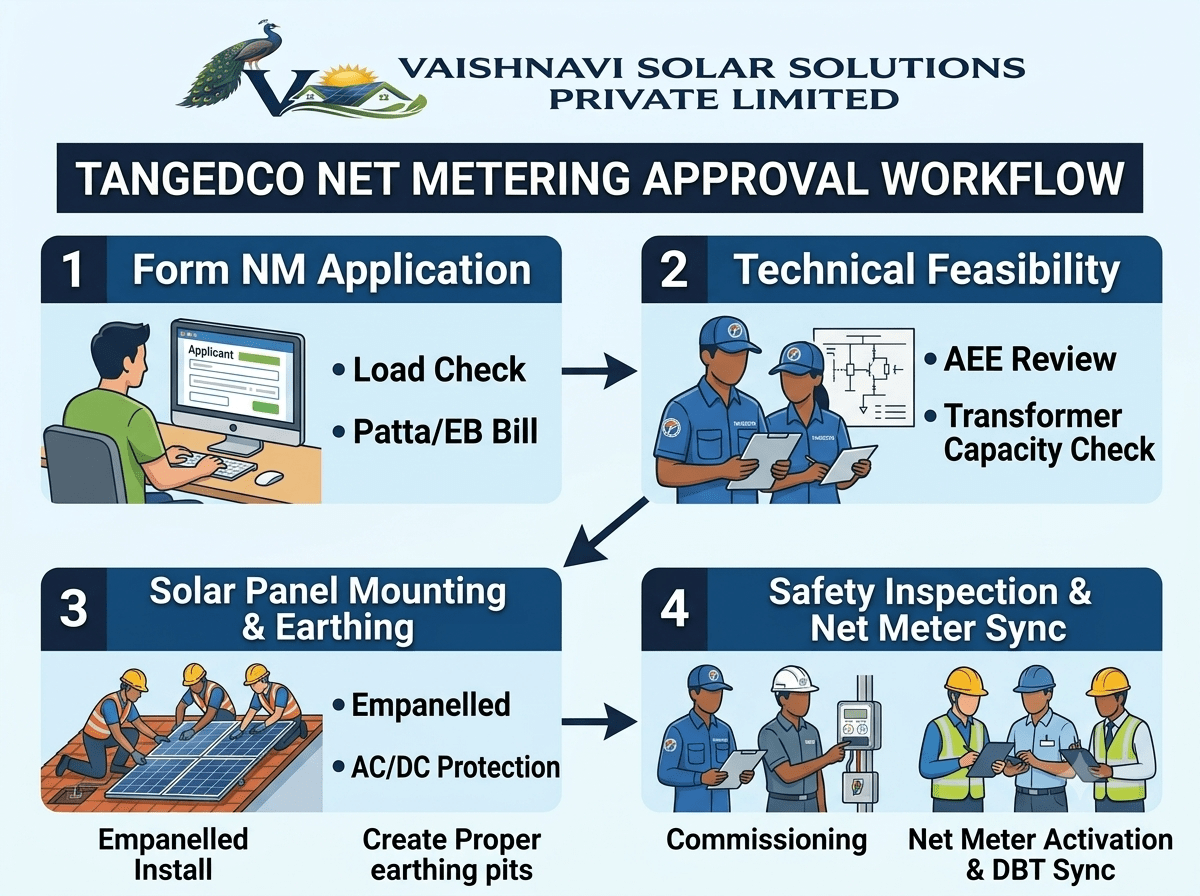
Step 1: Submitting Form NM and Sanction Load Verification
Before purchasing hardware, your installer submits Form NM (Net Metering Application) to TANGEDCO along with a nominal application fee.
Your proposed solar plant capacity (in kW) cannot exceed your sanctioned service connection load. For example, if your home has a 3 kW sanctioned load, your solar plant cannot exceed 3 kW unless you submit a load enhancement request first.
Step 2: Technical Feasibility Clearance
The local Assistant Executive Engineer (AEE) reviews your local distribution transformer capacity. Under TANGEDCO rules, grid-connected solar capacity on a local transformer is capped at 30% of the transformer’s total rated capacity. Approval is granted on a first-come, first-served basis.
Step 3: Physical Installation and Safety Inspection
Once feasibility is approved, physical mounting begins. Your vendor installs:
MNRE-approved Tier-1 solar modules.
A grid-tied inverter with certified anti-islanding protection (which automatically shuts down solar feed during local grid blackouts to protect line workers).
Dedicated AC/DC surge protection devices and proper earthing pits.
For system capacities below 10 kW, the TANGEDCO Assistant Executive Engineer (AEE) conducts the site inspection. For systems 10 kW and above, inspection clearance from the Tamil Nadu Electrical Inspectorate (TNEI) is required.
Step 4: Signing the Net Metering Agreement & Meter Replacement
After safety verification, you sign the formal Net Metering Agreement with TANGEDCO. The section office schedules an engineer to replace your old meter with an approved bi-directional net meter. Your solar plant is then officially energized and synced to the grid!
To review component specifications or request turnkey installation, visit our Rooftop Solar Services Page.
Understanding Solar Network Charges and Billing Adjustments
When reading your TANGEDCO bi-monthly bill after installing net metering, you will notice a small line item called Network Charges (or wheeling charges).
Under TNERC regulations, residential solar installations up to 10 kW pay only 20% of the standard network charge rate per unit of solar energy generated.
This nominal fee covers grid stabilization and maintenance, usually amounting to just a few hundred rupees per billing cycle.
It is automatically offset by the thousands of rupees you save on overall energy consumption charges.
What Happens to Unused Export Credits at the End of the Year?
If your solar plant consistently produces more units than you consume throughout the year, excess credits roll forward every two months. At the end of the annual settlement cycle (March 31st), TANGEDCO settles remaining unused export credits at the state regulatory commission’s benchmark tariff rate.
Eliminate Net Metering Delays with Expert Support
Filing net metering paperwork, calculating sanctioned load limits, and managing section office inspections on your own can take weeks of continuous follow-ups.
At Vaishnavi Solar Solutions Private Limited, our team handles the full net metering workflow—from initial feasibility applications and single-line diagram (SLD) drawings to inspection coordination and net meter installation.
Want to convert your home or business to solar without paperwork headaches? Visit our Contact Us Page or call our engineering team at +91 9080936356 for a free site feasibility survey today!